Stop drowning in paper lists. Consensus is an AI search engine built for research: you ask a plain-English question and it answers from more than 220 million peer-reviewed papers, with every claim linked to the study behind it. For students, clinicians, and researchers who already use tools like NotebookLM to organise sources, Consensus is the fastest way to find trustworthy evidence in the first place.
What is Consensus?
Consensus is an evidence-first academic search engine used by over 10 million researchers, clinicians, and students. Unlike a general AI answer engine, it searches scholarly literature before it writes anything, then synthesises findings across studies instead of cherry-picking a single result. Partnerships with major academic publishers also give it licensed full-text access to millions of paywalled papers, so answers can draw on methods and results sections, not just abstracts.
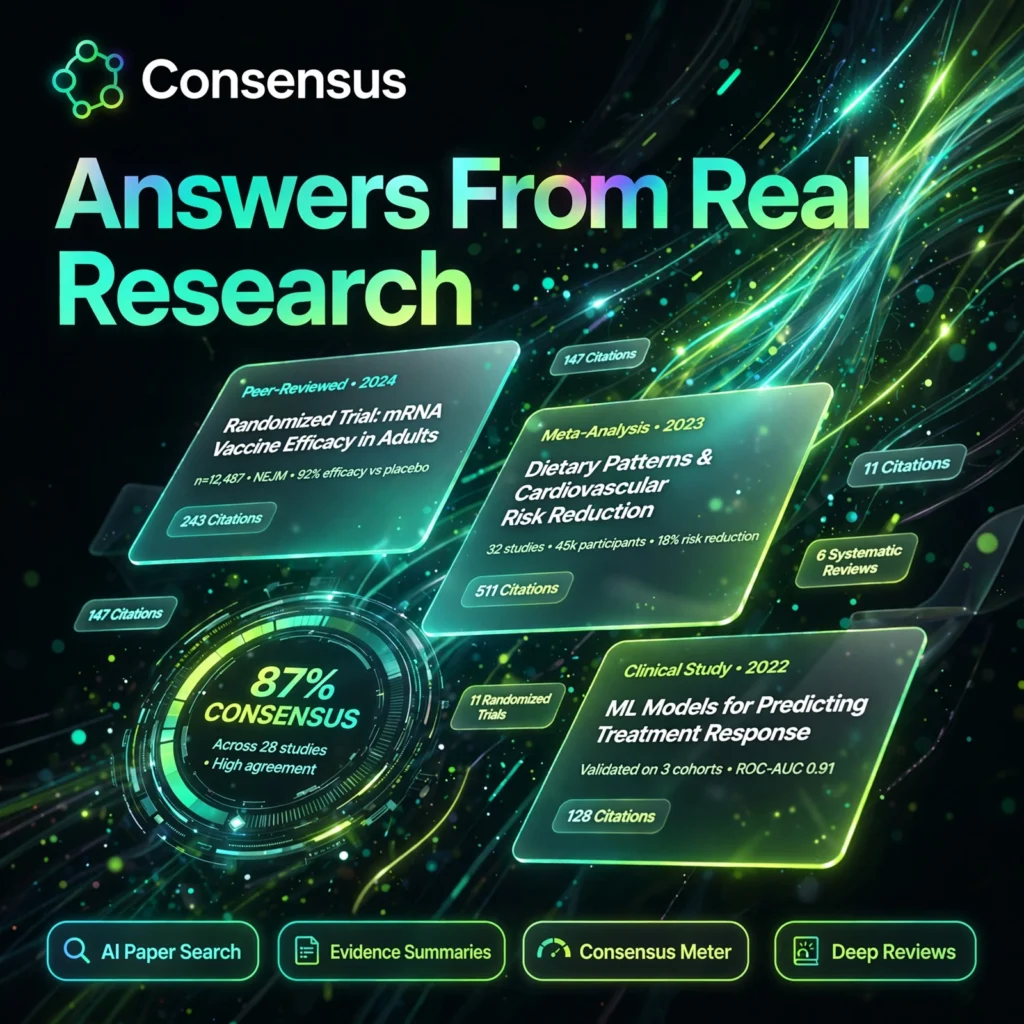
Each result shows the paper title, a one-sentence key finding, citation count, study type, and journal quality signals, so you can judge the evidence at a glance and open the source paper in one click.
Key Features of Consensus
Here are the standout features that make Consensus a favourite research companion:
- AI Paper Search: Ask natural-language research questions and search 220M+ peer-reviewed papers, ranked by relevance to your question rather than keyword overlap.
- Consensus Meter: For yes-or-no questions, a visual meter shows what percentage of studies support or refute a claim, so you see the balance of evidence instantly.
- Evidence Summaries: AI-written syntheses combine findings from the top papers, with inline citations you can verify against the original studies.
- Study Snapshots: One-card summaries of a paper’s methods, sample size, population, and key findings, helping you screen studies in seconds.
- Deep Reviews: Multi-step literature reviews that plan searches, apply quality filters, and produce long-form, fully cited reports on a topic.
- Quality Filters: Narrow results to randomised controlled trials, meta-analyses, human studies, minimum sample sizes, or top-quartile journals, and sync your library with Zotero.
How to Use Consensus
Getting evidence-backed answers takes only a few minutes:
- Create a free account: Go to consensus.app and sign up with email or Google — the free tier activates immediately, no card required.
- Ask a real question: Type a full question such as “Does creatine improve strength in trained athletes?” rather than keywords, and let the AI search the literature.
- Read the synthesis: Check the Consensus Meter and the cited summary, then scan Study Snapshots to compare methods and sample sizes.
- Filter for quality: Restrict results by study design, date range, or journal quality when you need only the strongest evidence.
- Save and export: Save papers to your library, organise them in Collections, and export citations for your paper or report.
Pro tip: Pair Consensus with a general assistant like ChatGPT — find the evidence in Consensus first, then draft your write-up with citations you have already verified.
Consensus Pricing Plans
Consensus is freemium, with a genuinely useful free tier and paid plans for heavy research work:
- Free – $0: Unlimited paper searches, 10 Pro messages, 3 Deep Reviews, and 10 Study Snapshots per month.
- Pro – $20/month or $144/year: Unlimited Pro messages, 15 Deep Reviews per month, and unlimited Study Snapshots.
- Deep – $65/month or $540/year: Everything in Pro plus 200 Deep Reviews per month for frequent literature-review work.
- Teams & Enterprise – Custom: Shared administration, centralised billing, library integrations, and higher-volume access for institutions.
Students and faculty can apply for a discount, which makes Pro one of the best-value upgrades in the research-tool category.
Pros and Cons of Consensus
Pros:
- Answers grounded in 220M+ peer-reviewed papers, with citations on every claim
- Consensus Meter makes the strength and direction of evidence immediately clear
- Generous free tier with real Deep Reviews included every month
- Licensed full-text access to millions of paywalled papers
Cons:
- Coverage is deepest in medicine and the sciences; thinner for law and humanities
- AI summaries can miss nuance — critical claims still need checking in the source paper
- Not a replacement for a full systematic review in clinical or regulatory work
Frequently Asked Questions
Is Consensus free to use?
Yes. The free plan includes unlimited paper searches, 10 Pro messages, 3 Deep Reviews, and 10 Study Snapshots per month, with no credit card required. Pro ($20/month) removes the Pro message limit and adds more Deep Reviews.
How is Consensus different from Google Scholar?
Google Scholar returns lists of papers for keyword searches. Consensus answers a natural-language question directly: it reads and synthesises findings across studies, shows a Consensus Meter for yes/no questions, and cites the exact paper behind every claim.
Can Consensus read paywalled papers?
Yes, for millions of titles. Through partnerships with major academic publishers, Consensus has licensed full-text access to many paywalled papers, so its search can use methods and results sections rather than abstracts alone. Access still varies by publisher and field.
Who should use Consensus?
Students, researchers, clinicians, and evidence-driven writers who need fast, cited answers from real studies. It is ideal for literature reviews, fact-checking health and science claims, and finding the strongest papers on a question before deeper reading.