
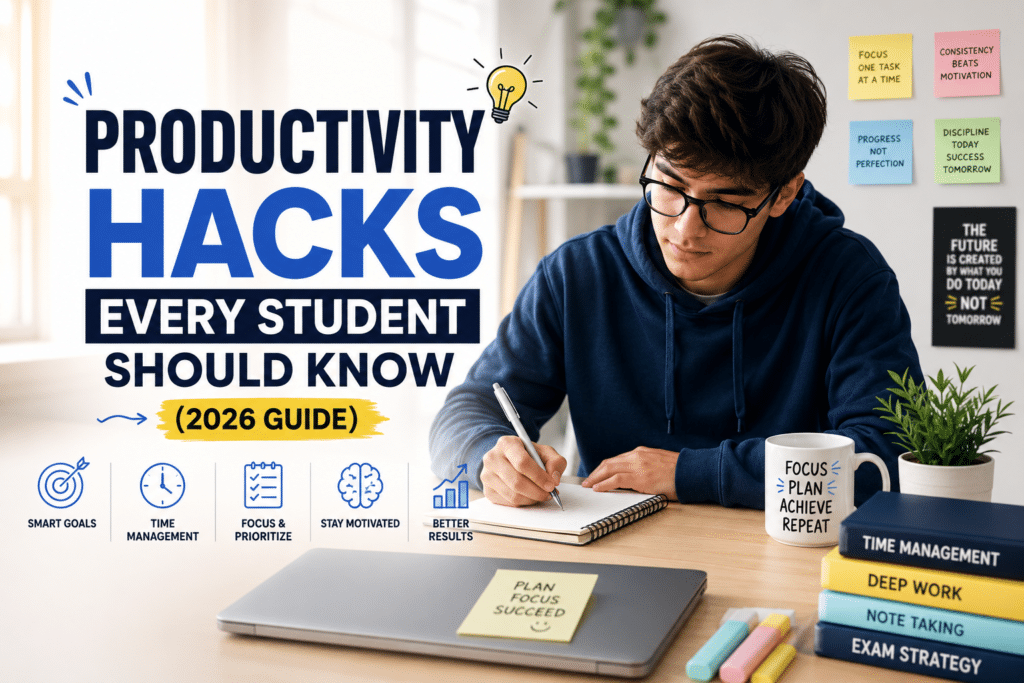
Between classes, assignments, exams, part-time jobs, and trying to have some semblance of a social life, student life can feel like a constant juggling act. The students who seem to manage it all aren’t necessarily smarter or working harder – they’re often just using a few simple productivity hacks consistently.
These hacks aren’t complicated systems that take weeks to set up. They’re practical, easy-to-apply techniques that help you study more effectively, manage deadlines without last-minute panic, and still have time for the things you enjoy.
In this guide, you’ll discover practical productivity hacks designed specifically for student life – covering studying, time management, assignments, and exam preparation.
Why Students Often Struggle With Productivity
Student schedules are unique compared to a typical 9-to-5 job. Classes, assignments, and exams arrive in waves rather than a steady stream, which makes it easy to fall into a pattern of cramming before deadlines rather than working consistently.
On top of that, students often face significant social and digital distractions – roommates, social media, group chats – combined with environments (dorms, shared spaces, libraries) that aren’t always designed for focused work.
The hacks below are designed with these realities in mind – they’re meant to fit around an unpredictable schedule, not require you to build an entirely new routine from scratch.
Study Hacks That Improve Retention
1. Use Active Recall Instead of Re-Reading
Simply re-reading notes or textbooks feels productive but often results in poor long-term retention. Active recall – testing yourself on material without looking at your notes – is far more effective for actually remembering information during exams.
How to apply it: After reading a section, close your notes and try to write down or explain the key points from memory. Then check what you missed and review just those gaps.
2. Space Out Your Study Sessions
Studying the same material in short sessions spread across several days is more effective for long-term retention than one long session the night before. This is sometimes called “spaced repetition.”
How to apply it: Instead of one 4-hour study session, try four 1-hour sessions spread across several days, revisiting the same material each time.
3. Teach What You’re Learning
Explaining a concept to someone else – or even just out loud to yourself – forces you to organize the information in a way that simple reading doesn’t. If you can’t explain it simply, that’s often a sign you need to review it further.
Time Management Hacks for a Packed Schedule
4. Use a Single Calendar for Everything
Classes, assignment deadlines, work shifts, and social plans often end up scattered across different apps, planners, and sticky notes. Combining everything into a single calendar – even a simple one – reduces the chance of conflicts and missed deadlines.
Google Calendar works well for this, since it’s free, accessible from any device, and allows for color-coding different types of commitments.
5. Work Backward From Deadlines
Instead of starting an assignment when it’s due soon, work backward from the deadline to create mini-deadlines for each stage – research, outline, draft, review. This breaks a large task into manageable pieces and avoids last-minute scrambling.
6. Use the Eisenhower Matrix for Competing Priorities
When you have multiple assignments, readings, and commitments competing for attention, the Eisenhower Matrix can help you quickly identify what’s truly urgent and important versus what feels pressing but can wait.
Assignment and Project Hacks
7. Start With the Hardest Part First
It’s tempting to start an assignment with the easiest section to build momentum, but this often means the hardest part gets pushed to when you’re most tired and have the least time. Tackling the most challenging section first – while your energy is highest – often leads to better results overall.
8. Break Large Projects Into Small, Specific Tasks
“Write the essay” is overwhelming and vague. Breaking it into smaller tasks – “create an outline,” “write the introduction,” “find three sources for the second argument” – makes it much easier to start, and gives you a sense of progress along the way.
9. Use Templates for Common Assignment Types
If you regularly write similar types of assignments (lab reports, essays, presentations), creating a basic template or structure you can reuse saves time on formatting and structure, letting you focus on the actual content each time.
Exam Preparation Hacks
10. Create a Study Schedule Well Before Exams
Cramming the night before an exam is one of the least effective study strategies, yet one of the most common. Creating a study schedule 1-2 weeks before exams – spreading topics across multiple sessions – takes advantage of spaced repetition and reduces last-minute stress.
11. Use Practice Tests Whenever Possible
Practice tests combine active recall with exposure to the exam format itself, helping you identify gaps in your knowledge while also becoming familiar with the type of questions you’ll face.
12. Study in Focused Blocks With Breaks
Long, unbroken study sessions lead to diminishing returns as mental fatigue builds. Using the Pomodoro Technique – 25 minutes of focused studying followed by a 5-minute break – helps maintain better concentration over longer study sessions.
Focus Hacks for Distraction-Heavy Environments
13. Choose Your Study Location Intentionally
Not all environments are equally good for focus. A noisy common room, a bed, or a space full of distractions (like a phone within easy reach) all make focus harder. Libraries, quiet study rooms, or even a specific desk reserved for studying can help create a stronger focus association.
14. Put Your Phone Out of Reach
Simply having your phone visible – even face down – can pull at your attention. Placing it in another room, a bag, or a drawer during study sessions removes the temptation to “just check” something.
15. Use Apps That Block Distracting Sites
Forest and similar app blockers can prevent access to distracting apps and websites during scheduled study sessions, removing the option to get distracted rather than relying purely on willpower.
Productivity Hacks for Group Projects and Study Groups
Group projects and study groups bring their own productivity challenges – coordinating schedules, dividing work fairly, and avoiding the common trap of meetings that don’t actually move anything forward.
16. Define Roles and Deliverables Early
Vague group assignments (“we’ll all work on it together”) often lead to duplicated effort in some areas and gaps in others. Spending 10-15 minutes at the start clearly dividing responsibilities – who does what, and by when – saves much more time later than it costs upfront.
17. Use Shared Documents for Real-Time Collaboration
Rather than emailing different versions of a document back and forth, shared documents (like Google Docs) allow everyone to see the latest version and contribute simultaneously, reducing the confusion and lost time that comes with managing multiple file versions.
18. Keep Group Study Sessions Focused
Study groups can easily turn into social time rather than study time. Setting a specific agenda for each session – topics to cover, practice questions to work through – helps keep the group on track while still benefiting from discussion and different perspectives.
Building Long-Term Productivity Habits as a Student
The hacks covered so far are practical and immediate, but a few longer-term habits can compound over an entire semester or academic year.
Do a Weekly Planning Session
Spending 15-20 minutes at the start of each week reviewing upcoming deadlines, classes, and commitments – and adjusting your study schedule accordingly – prevents the buildup of forgotten tasks and last-minute surprises. This is similar to the weekly review process used by many productive professionals.
Reflect After Major Assignments and Exams
After finishing a big assignment or exam, take a few minutes to reflect: What worked well? What would you do differently next time? This small habit helps you continuously refine your approach rather than repeating the same struggles every semester.
Protect Time for Rest, Not Just Study
Long-term academic performance depends heavily on avoiding burnout. Scheduling downtime – even small amounts – alongside your study schedule helps maintain the energy and motivation needed to sustain good habits over an entire term, not just a single week.
Balancing Productivity With Student Life
It’s worth remembering that the goal of these hacks isn’t to fill every hour with studying – it’s to make your study time more effective, so you have genuine time left for rest, friends, and activities you enjoy.
A few principles help maintain this balance:
- Schedule downtime, not just study time. Treating breaks and social time as part of your schedule – rather than “whatever’s left over” – helps prevent burnout.
- Protect your sleep. Sleep deprivation directly affects memory, concentration, and mood – all of which are essential for both studying and enjoying student life.
- Don’t aim for perfection every day. Some days will be less productive than others. The goal is consistency over time, not a perfect record.
Frequently Asked Questions
What’s the single most effective study hack?
For most students, active recall – testing yourself rather than just re-reading – produces the biggest improvement in exam performance relative to the time invested.
How far in advance should I start studying for exams?
Starting 1-2 weeks before an exam, with material spread across multiple short sessions, is far more effective than cramming the night before. Even starting just a few extra days earlier than you normally would can make a noticeable difference.
How do I stay productive when my schedule changes every day?
Using a single calendar that includes both fixed commitments (classes, work) and flexible study blocks helps you adapt day to day while still maintaining structure. Working backward from deadlines also helps, since it doesn’t depend on a fixed daily routine.
What if I get distracted by my phone constantly while studying?
Physically separating yourself from your phone – placing it in another room or using an app blocker – is far more effective than simply trying to resist checking it while it’s nearby.
Is it bad to study for long hours without breaks?
Yes – long, unbroken study sessions lead to diminishing returns as fatigue builds, meaning the later hours often produce far less learning per hour than the earlier ones. Breaking study time into focused blocks with breaks tends to produce better results, even with the same total time invested.
What is active recall and why does it work?
Active recall is the practice of testing yourself on material without looking at your notes, which strengthens memory far more effectively than simply re-reading, since it forces your brain to actively retrieve information rather than passively recognize it.
How can I avoid procrastinating on assignments?
Breaking large assignments into small, specific tasks and starting with the hardest part first, while your energy is highest, makes assignments feel far less overwhelming and reduces the urge to put them off.
What is spaced repetition?
Spaced repetition means studying the same material in short sessions spread across several days rather than in one long session, which significantly improves long-term retention compared to cramming.
Is the Pomodoro Technique good for studying?
Yes, studying in focused blocks of around 25 minutes followed by short breaks, as used in the Pomodoro Technique, helps maintain concentration over longer study sessions and prevents mental fatigue.
How do I make group study sessions more productive?
Setting a specific agenda for each group study session, including the exact topics or practice questions to cover, helps keep the group focused on studying rather than drifting into social time.
Conclusion: Small Hacks, Better Grades and More Free Time
Student productivity isn’t about studying every waking hour – it’s about using techniques that make your study time more effective, so you can manage deadlines with less stress and still have time for everything else in your life.
Here’s a quick recap of the hacks covered in this guide:
- Study hacks: Active recall, spaced repetition, teaching what you’ve learned
- Time management hacks: A single calendar, working backward from deadlines, the Eisenhower Matrix
- Assignment hacks: Start with the hardest part, break projects into small tasks, use templates
- Exam hacks: Early study schedules, practice tests, focused study blocks
- Focus hacks: Intentional study locations, phone out of reach, app blockers
Do this one thing today: Pick your next assignment or exam, and write down 2-3 mini-deadlines working backward from the due date. This single step makes the entire task feel more manageable.