
Some days you get through your to-do list with energy to spare. Other days, you stare at the same task for an hour and barely move forward. The difference usually isn’t motivation – it’s a handful of small habits and routines that either work for you or against you.
The good news? You don’t need a complete life overhaul to feel more productive. Small, proven adjustments to how you start your day, manage your energy, and structure your work can add up to a noticeable difference within days.
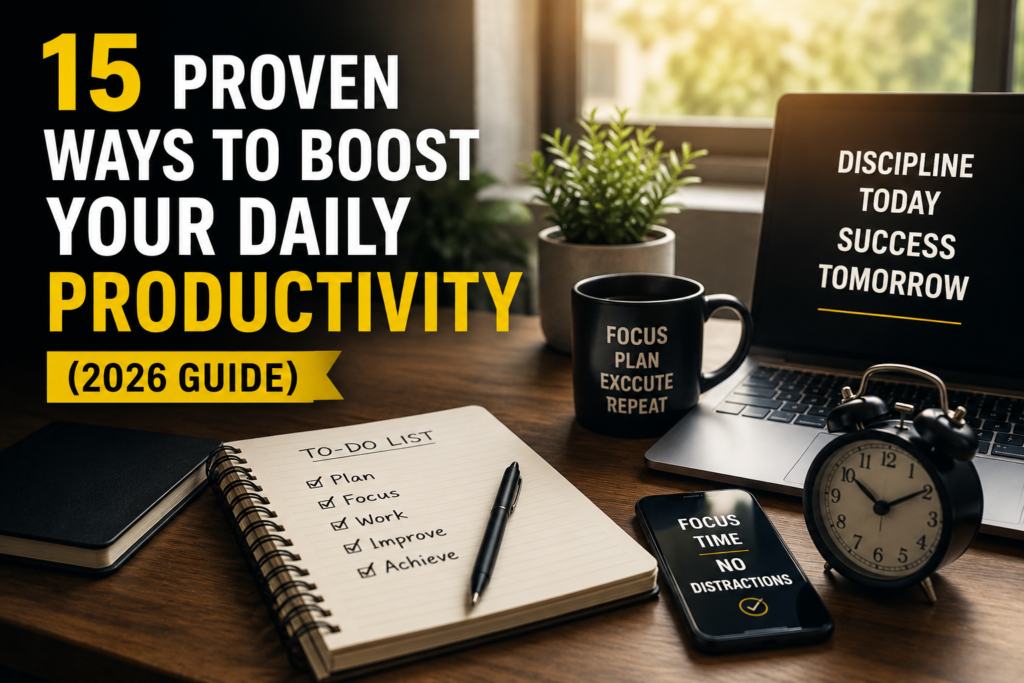
In this guide, you’ll discover 15 proven, practical ways to boost your daily productivity – backed by research and easy to start using today, whether you work in an office, from home, or as a student.
What Actually Affects Daily Productivity?
Productivity isn’t just about working harder or longer – it’s about how effectively you use your attention, energy, and time. Three factors influence this more than anything else: focus (how well you concentrate on one thing), energy (your physical and mental capacity to work), and structure (how your day is organized).
In 2026, with hybrid schedules, constant notifications, and information overload, all three of these factors are under more pressure than ever. The strategies below target each of these areas, so you can build a day that supports steady output rather than constant struggle.
Let’s start with how you begin your day – because the first hour often sets the tone for everything that follows.
Morning Strategies to Start Strong
1. Decide Your Top Priority the Night Before
If you wait until morning to decide what matters most, your tired brain will often default to the easiest task, not the most important one. Choosing your single most important task the night before removes that decision and gives your morning a clear direction from the start.
2. Delay Email and Messages
Opening your inbox first thing hands control of your morning to other people’s priorities. Even a “quick check” can turn into 20-30 minutes of reactive work. Try giving yourself the first 30-60 minutes of your day for your own priority before checking messages.
3. Use a Simple Morning Routine
You don’t need an elaborate ritual – even a short, consistent sequence (water, a few minutes of movement, reviewing your top priority) signals to your brain that the workday has begun, helping you transition into focus mode more smoothly.
For a deeper look at how high performers structure their mornings, see our guide on morning routines of highly productive people.
Strategies to Sharpen Your Focus
4. Work in Focused Time Blocks
Instead of working continuously for hours, break your work into focused intervals with short breaks in between. The Pomodoro Technique – 25 minutes of focused work followed by a 5-minute break – is one of the simplest and most effective ways to do this.
5. Single-Task Your Most Important Work
Multitasking on demanding tasks creates “switching costs” that slow you down overall, even though it feels productive in the moment. For your highest-priority task, close unrelated tabs and apps, and give it your full attention for a set period.
6. Turn Off Non-Essential Notifications
Every notification – even ones you ignore – pulls a small amount of attention away from what you’re doing. Turning off notifications for apps that don’t require real-time responses helps protect your focus throughout the day.
7. Use the Two-Minute Rule for Small Tasks
If something takes less than two minutes – replying to a quick message, filing a document – do it immediately rather than adding it to your list. This prevents small tasks from piling up into a backlog that eats an entire afternoon later.
Strategies to Manage Your Energy
8. Match Tasks to Your Energy Levels
Most people have a time of day when they feel sharpest – often mid-morning – and times when energy naturally dips, commonly in the early afternoon. Schedule your hardest, most important work during your peak energy window, and save routine or administrative tasks for lower-energy periods.
9. Take Real Breaks – Not Just Screen Breaks
Switching from work to scrolling social media isn’t a real break – it’s still mentally stimulating. Genuine breaks involve stepping away from screens: stretching, walking, getting water, or simply looking out a window. These short resets help prevent the gradual buildup of mental fatigue.
10. Move Your Body Throughout the Day
Sitting for long periods without movement is linked to reduced alertness and energy. Even short movement breaks – a 5-minute walk, some stretching, or standing up while on a call – can help maintain steadier focus across the day.
11. Protect Your Sleep Schedule
No productivity technique can fully compensate for chronic sleep deprivation. Poor sleep directly affects concentration, decision-making, and mood – the foundations that every other strategy on this list depends on.
Strategies to Improve Your Environment
12. Create a Dedicated Workspace
Your environment shapes your focus more than most people realize. A cluttered desk, background noise, or a space associated with relaxation can all create small, constant pulls on your attention. Even a small, consistent workspace helps your brain switch into “work mode” more easily.
For remote workers especially, environment plays a huge role – see our full guide on how to stay focused while working from home.
13. Reduce Visual and Digital Clutter
An overflowing browser with dozens of tabs, a messy desktop, or piles of papers all create low-level visual noise that competes for your attention. Periodically clearing this clutter – closing unused tabs, organizing files – removes these small distractions.
14. Use Tools That Match Your Workflow
The right tools can remove friction from your day, but too many tools can add overhead instead. Choose one main system for tasks and one for scheduling – Notion for tasks and projects, and Google Calendar for scheduling, cover most needs for most people.
Strategies to Reflect and Improve
15. Do a Quick End-of-Day Review
Spend 5-10 minutes at the end of each day reviewing what you completed, noting what’s left for tomorrow, and identifying your next day’s top priority. This small habit creates a smooth transition between days and prevents the “where did I leave off?” confusion that often slows down the next morning.
For a more structured version of this, try a weekly review every Sunday to plan your upcoming week and adjust your approach based on what worked.
Tracking Your Progress Without Overcomplicating It
One question that comes up often: how do you know if these strategies are actually working? You don’t need elaborate spreadsheets or tracking apps to find out – a few simple signals are usually enough.
Notice How Often You Finish Your Top Priority
Before adopting new strategies, take note of how often you actually complete the single most important task you set for yourself each day. After a week or two of applying a few strategies, check again. An increase in this number is often the clearest sign that something is working.
Pay Attention to How Your Afternoons Feel
Many people notice the biggest shift in their afternoons – the period when energy typically dips and focus becomes harder to maintain. If strategies like matching tasks to energy levels and taking real breaks are working, afternoons often feel less like a slow decline and more like a natural, manageable part of the day.
Watch for Fewer “Where Did the Day Go?” Moments
A common sign of unstructured days is reaching the evening and feeling unsure where the time went, despite feeling busy all day. As structure improves – through time blocks, reduced notifications, and clearer priorities – most people notice this feeling becomes less frequent, replaced by a clearer sense of what was accomplished.
Adapting These Strategies to Different Work Styles
Not every strategy will feel natural for every type of work or personality. Here’s how to think about adapting them.
For Creative Work
Creative tasks – writing, design, brainstorming – often benefit from longer, less rigidly structured focus blocks compared to administrative tasks. If 25-minute Pomodoro sessions feel too disruptive for creative flow, try extending to 45-50 minute blocks with slightly longer breaks.
For Highly Collaborative Roles
If your role involves frequent meetings and collaboration, protecting large blocks of focus time may be harder. In this case, focus on smaller wins: even 20-30 minutes of protected time between meetings, combined with strong notification management, can make a meaningful difference.
For Variable or Unpredictable Schedules
If your daily schedule changes frequently – common for parents, freelancers, or shift workers – prioritize the strategies that don’t depend on a fixed routine: deciding your top priority in advance, the two-minute rule, and protecting sleep. These provide structure even when external circumstances are unpredictable.
Which Strategies Should You Start With?
Trying to implement all 15 strategies at once is overwhelming and usually leads to giving up on all of them. Instead, follow this simple approach:
- Pick 2-3 strategies that address your biggest current frustration – constant distractions, low energy, or a chaotic morning.
- Apply them consistently for two weeks before judging the results. New habits take time to feel automatic.
- Add 1-2 more strategies once the first set feels natural, rather than stacking everything at once.
Expert recommendation: If you’re not sure where to start, begin with deciding your top priority the night before (#1) and working in focused time blocks (#4). These two strategies have the widest ripple effect across the rest of your day.
Frequently Asked Questions
How quickly will I notice a difference?
Some strategies, like turning off notifications or using the two-minute rule, can show benefits within a day or two. Others, like matching tasks to your energy levels or building a morning routine, may take 1-2 weeks of consistent practice before you notice a clear shift.
Do I need to do all 15 strategies every day?
No. Even consistently applying 4-5 of these strategies can create a noticeable improvement. Choose the ones that address your specific challenges rather than trying to do everything at once.
What if I have an unpredictable schedule?
Strategies like single-tasking, the two-minute rule, and protecting your sleep schedule work well even with unpredictable days, since they’re not tied to a fixed schedule. Focus on these “flexible” strategies first if your day-to-day structure varies a lot.
Is it normal to feel less productive some days even with these habits?
Yes. Productivity naturally fluctuates due to sleep, stress, and other factors outside your control. These strategies help raise your overall average and reduce the frequency of unproductive days, but occasional off-days are completely normal.
How does this connect to bigger productivity systems?
These 15 strategies work well as building blocks for larger systems. For a full overview of complete productivity frameworks, see our guide to 10 effective time management techniques.
Conclusion: Small Strategies, Real Results
Boosting your daily productivity doesn’t require dramatic changes – it requires consistent attention to focus, energy, and structure. Each of the 15 strategies in this guide is small enough to start today, but powerful enough to compound over time.
Here’s a quick recap of the categories covered:
- Morning strategies: Decide priorities the night before, delay messages, build a simple routine
- Focus strategies: Work in time blocks, single-task important work, reduce notifications, use the two-minute rule
- Energy strategies: Match tasks to energy levels, take real breaks, move regularly, protect sleep
- Environment strategies: Dedicated workspace, reduce clutter, use the right tools
- Review strategies: Quick daily review, weekly planning session
Do this one thing today: Before you finish work, write down tomorrow’s single most important task. It takes 30 seconds and sets the direction for a more focused day ahead.