
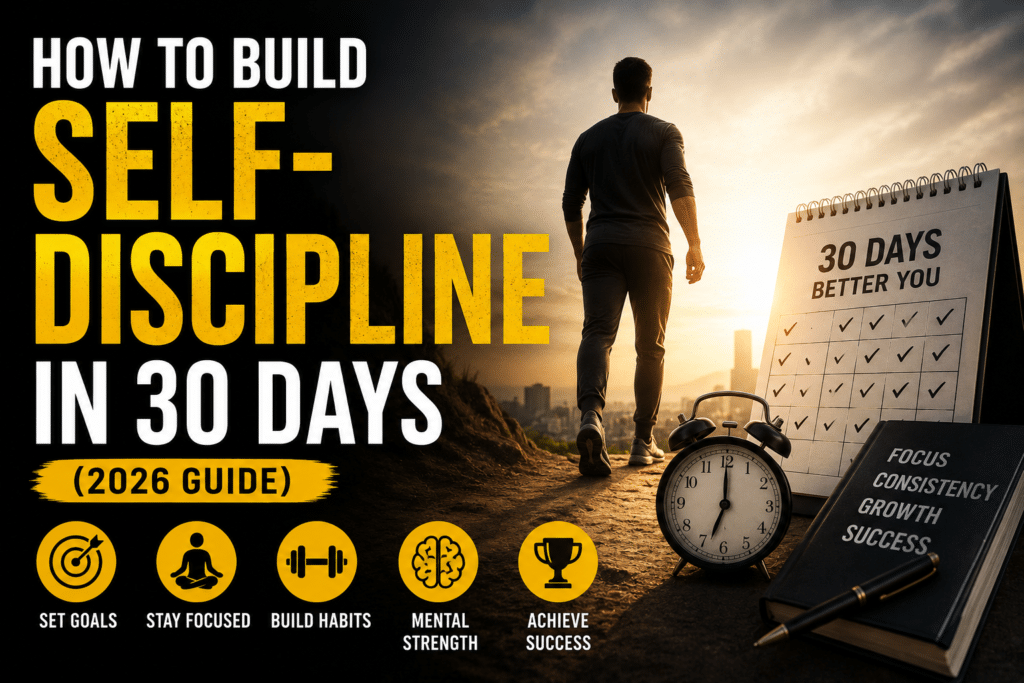
Self-discipline is often misunderstood as something you either have or don’t – a fixed personality trait that some lucky people are simply born with. The truth is far more encouraging: self-discipline is a skill, and like any skill, it can be deliberately trained.
You don’t need to overhaul your entire personality to become more disciplined. You need a structured, realistic plan that Build Self Discipline the habit gradually – which is exactly what this 30-day guide provides.
In this guide, you’ll learn what self-discipline actually is, the science behind building it, and a practical day-by-day approach to strengthening it over the next 30 days.
What Self Discipline Really Is
Self-discipline is the ability to follow through on a decision or commitment even when motivation is low, distractions are present, or an easier alternative is available. It’s not about feeling motivated all the time – in fact, relying on motivation alone is precisely what self-discipline helps you overcome.
A useful way to think about it: motivation gets you started, but discipline keeps you going once the initial excitement fades. Since motivation naturally fluctuates day to day, discipline acts as the more reliable backup system for following through.
The Science Behind Build Self Discipline
Discipline Works Like a Muscle, With Limits
Self-control draws on a limited mental resource that can be depleted through overuse in a single day – a concept often referred to as decision fatigue. This is why discipline often feels harder later in the day, after many small decisions have already been made.
Habits Reduce the Need for Willpower
Once a behavior becomes automatic – a true habit rather than a conscious decision – it requires far less willpower to maintain. This is the central goal of the 30-day approach below: gradually shifting disciplined actions from requiring effort to becoming automatic.
Small, Consistent Wins Build Capacity Over Time
Just as physical strength builds gradually through consistent, appropriately challenging practice, self-discipline strengthens through repeated small wins rather than occasional, overwhelming tests of willpower. This connects closely to the idea that small daily improvements compound into significant results over time.
Week 1: Building Awareness and Small Wins
The first week focuses on building self-awareness and creating early momentum with achievable wins, rather than diving into intense, willpower-heavy changes.
Days 1-3: Identify One Specific Area to Focus On
Trying to build discipline across every area of life at once spreads your effort too thin. Choose one specific area – consistent exercise, focused work sessions, healthier eating, or limiting a particular distraction – and commit to focusing there for the full 30 days.
Days 4-5: Define the Smallest Possible Version of the Habit
Rather than starting with an ambitious version of your chosen habit, define the smallest version that still counts as progress. If your focus is exercise, the smallest version might be “put on workout clothes and do 5 minutes of movement” rather than “complete a full workout.”
Days 6-7: Track Your First Wins
Use a simple tracker – a calendar, notebook, or app – to mark each day you complete your small habit. Tracking progress significantly increases your odds of long-term success, and seeing early wins builds confidence for the weeks ahead.
Week 2: Strengthening Consistency
With initial momentum established, the second week focuses on reinforcing consistency and starting to build structure around your habit.
Days 8-10: Attach Your Habit to an Existing Routine
Linking your discipline habit to something you already do consistently makes it far easier to remember and follow through on. For example: “After I brush my teeth in the morning, I’ll do my 5 minutes of movement.”
Days 11-12: Remove Friction That Makes the Habit Harder
Identify anything currently making your habit harder to follow through on, and remove it. This might mean preparing workout clothes the night before, or placing a book on your pillow as a reminder to read before checking your phone.
Days 13-14: Gradually Increase the Challenge Slightly
If your small habit has felt consistent for a week or more, consider a slight increase – from 5 minutes of movement to 10, for example. The key word is “slight” – the goal is gradual growth, not a sudden jump back to an intense, hard-to-sustain version.
Week 3: Handling Setbacks and Temptation
By the third week, the novelty of a new habit often fades, and this is typically when discipline is tested the most. This week focuses on building resilience against setbacks.
Days 15-17: Plan for Specific Obstacles in Advance
Identify the situations most likely to derail your habit – a busy workday, social plans, low energy – and decide in advance how you’ll handle them. This is sometimes called an “implementation intention”: “If I’m too busy for my full habit, I’ll do the 2-minute version instead of skipping entirely.”
Days 18-19: Practice Recovering Quickly After a Miss
If you miss a day during this week, treat it as data, not failure. Notice what got in the way, adjust if needed, and resume the very next day. The speed of recovery matters far more than achieving a perfect streak.
Days 20-21: Reduce Reliance on Motivation
By now, your habit should rely less on feeling motivated and more on the structure you’ve built – the routine, the small size, the reduced friction. Notice days when you complete the habit despite low motivation; this is a clear sign discipline is strengthening.
Week 4: Making Discipline Feel Automatic
The final week focuses on consolidating the habit and planning for its continuation beyond the 30-day window.
Days 22-24: Reflect on What’s Changed
Compare how the habit feels now versus how it felt on day 1. Most people notice it requires noticeably less conscious effort – a clear sign that the behavior is shifting from a deliberate decision to a more automatic habit.
Days 25-27: Consider Expanding to a Second Area
If your first habit feels largely automatic, this is a good point to consider applying the same structured approach to a second area of discipline – though it’s equally fine to continue strengthening just the first habit for longer before adding more.
Days 28-30: Plan for Long-Term Maintenance
As the 30 days come to a close, decide how you’ll continue the habit going forward. Will you maintain the current version, or continue gradually increasing the challenge? Building this plan prevents the common pattern of habits fading once a structured challenge officially ends.
Why Discipline Matters More Than Motivation Long-Term
Many people approach personal change by waiting to “feel motivated” before taking action. The problem is that motivation is unpredictable and often fades exactly when it’s needed most – during difficult, unglamorous stretches of effort.
Self-discipline works differently. Instead of depending on how you feel in any given moment, it depends on structure, habit, and a clear plan that’s already been decided in advance. This is part of why sustaining long-term goals almost always relies more heavily on discipline and systems than on maintaining constant enthusiasm.
This doesn’t mean motivation is unimportant – it’s often what initiates a new commitment in the first place. But discipline is what carries that commitment through the months when motivation has naturally declined, which is precisely the period this 30-day plan is designed to build.
Applying This Approach to Different Areas of Life
While this guide uses general examples, the same 30-day structure can be applied to nearly any area where discipline is the missing ingredient.
Discipline for Health and Fitness
Start with the smallest possible version of a health habit – a short walk, a glass of water before each meal, or five minutes of stretching – then follow the same weekly progression: build awareness, strengthen consistency, prepare for setbacks, and consolidate into an automatic routine.
Discipline for Focused Work
If your goal is more disciplined, focused work, start with a single short Pomodoro session each day, gradually increasing the number of sessions as the habit becomes more automatic across the four weeks.
Discipline for Financial Habits
For financial discipline, start with a small, consistent action – such as reviewing your spending for two minutes each evening – before gradually building toward more comprehensive budgeting or saving habits later in the 30 days.
Common Mistakes That Derail Discipline-Building
Mistake #1: Starting With Too Many Habits at Once
Trying to build discipline in multiple areas simultaneously – exercise, diet, focus, sleep – divides your limited willpower across too many fronts, making it harder to succeed at any single one. Focus on one area for the full 30 days before adding another.
Mistake #2: Setting the Bar Too High Initially
An overly ambitious starting point – an intense workout routine, a strict diet, hours of focused work – often leads to early burnout. Starting smaller than feels necessary makes consistency far more achievable in the critical early days.
Mistake #3: Treating a Missed Day as Total Failure
One missed day doesn’t erase previous progress, but treating it as a reason to abandon the entire effort does. Self-discipline isn’t about a perfect record – it’s about consistently returning to the habit, even after setbacks.
Mistake #4: Relying Purely on Willpower Instead of Structure
Trying to power through purely on motivation and willpower, without reducing friction or building supporting structure (like attaching the habit to an existing routine), makes the entire process much harder than it needs to be.
Frequently Asked Questions
Can self-discipline really be built in just 30 days?
Thirty days is enough time to noticeably strengthen a specific habit and build real momentum, though the underlying skill of discipline continues to develop well beyond this initial period. Think of 30 days as a strong starting foundation, not a finish line.
What if I miss several days in a row?
Missing several days is a sign to revisit your approach rather than abandon it. Consider whether the habit was set at an appropriate difficulty level, whether it’s properly attached to an existing routine, and whether friction has been sufficiently reduced – then resume with these adjustments.
Should I reward myself for staying disciplined?
Small rewards can help in the early stages, but the most sustainable motivation usually comes from noticing the habit becoming easier and observing real progress, supported by consistent tracking. Over-relying on external rewards can sometimes undermine the internal motivation needed for long-term consistency.
How does self-discipline relate to motivation?
Motivation is often what initiates a new behavior, while discipline is what sustains it once the initial enthusiasm fades. Since motivation is unreliable day to day, building discipline through structure and small consistent habits creates a far more dependable foundation for long-term goals.
Can I use this 30-day approach for multiple goals over time?
Yes – many people use this structure repeatedly, focusing on one specific habit or goal area per 30-day cycle. This sequential approach, focusing deeply on one habit before adding the next, tends to be far more sustainable than attempting major changes across multiple areas simultaneously.
Conclusion: Discipline Is a Skill You Can Train
Self-discipline isn’t a trait reserved for a fortunate few – it’s a skill that strengthens through deliberate, gradual practice. By starting small, reducing friction, planning for setbacks, and tracking your progress, 30 days is enough time to build a genuinely stronger foundation of discipline.
Here’s a quick recap of the 30-day approach:
- Week 1: Build awareness, choose one focus area, start with the smallest possible habit
- Week 2: Attach the habit to an existing routine, remove friction, increase gradually
- Week 3: Plan for obstacles in advance, practice recovering quickly from setbacks
- Week 4: Reflect on progress, consider expanding, plan for long-term maintenance
Do this one thing today: Choose your one focus area for the next 30 days, and define the smallest possible version of that habit you can start tomorrow.