

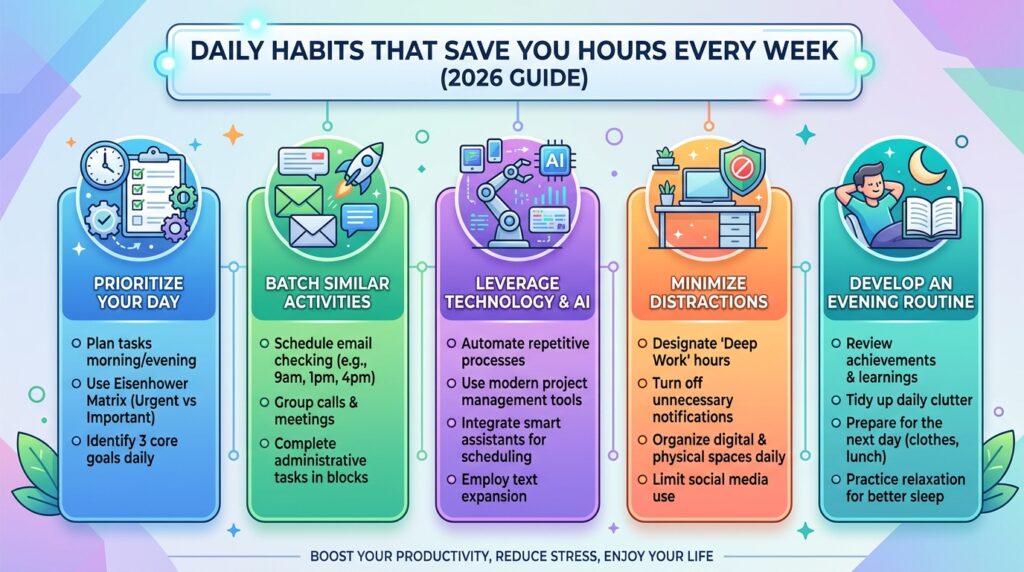
What if you could get back 5-10 hours every week – without working faster, skipping sleep, or sacrificing your weekends?
It sounds too good to be true, but it isn’t. The secret isn’t doing more – it’s eliminating the small, repeated habits that quietly drain your time every single day.
Most time management advice focuses on big systems and techniques. But often, the biggest wins come from small daily habits – tiny adjustments that take seconds to do but save minutes or hours when repeated day after day.
In this guide, you’ll discover practical daily habits that, once built, will free up hours of your week – almost without you noticing.
Why Small Habits Have a Big Impact
Imagine a habit that takes just 2 minutes but saves you 10 minutes of searching, backtracking, or redoing work. On its own, that’s a small win. But repeated five times a day, five days a week, it adds up to over 4 hours saved – every single week, from one small habit.
This is the power of daily habits: they’re automatic and repeated. Unlike a big productivity overhaul that requires constant willpower, a well-built habit runs in the background, saving time without requiring ongoing effort once it’s established.
The habits in this guide are grouped by time of day, so you can pick the ones that fit naturally into your existing routine rather than trying to adopt everything at once.
Morning Habits That Set the Tone
1. Identify Your Top Priority the Night Before
Deciding what to focus on first thing in the morning – when your brain is still waking up – often leads to choosing the easiest task rather than the most important one. By identifying your Most Important Task the night before, you remove that decision from your morning entirely.
Time saved: 15-20 minutes of morning indecision and “warming up” before starting real work.
2. Avoid Checking Email First Thing
Opening email first thing in the morning means your day’s priorities are immediately set by other people’s requests rather than your own plan. Even a quick “just checking” often turns into 20-30 minutes of reactive work before you’ve made any progress on your own priorities.
Time saved: 20-30 minutes of reactive morning work, plus the mental reset cost of switching back to your own priorities afterward.
3. Prepare Your Workspace the Night Before
Whether it’s setting out what you need for the day, closing unnecessary browser tabs, or organizing your desk, a prepared workspace removes small frictions that otherwise interrupt your morning momentum.
Time saved: 5-10 minutes of searching and setup, plus avoiding the small mental “reset” each interruption causes
Work Habits That Protect Your Focus
4. Batch Similar Tasks Together
Switching between different types of tasks – writing, then a quick call, then emails, then back to writing – creates a “switching cost” each time. Your brain needs a moment to re-engage with each new context.
Instead, group similar tasks together: handle all your calls in one block, all your emails in another, and protect a separate block for focused work like writing or analysis.
Time saved: Studies on task switching suggest grouping similar tasks can reduce wasted transition time by as much as 40% across a busy day.
5. Use the “Two-Minute Rule”
If a task takes less than two minutes – replying to a quick message, filing a document, scheduling a follow-up – do it immediately instead of adding it to your list. Adding it to a list means you’ll eventually have to read it again, decide on it again, and then do it – which often takes longer than just doing it now.
Time saved: While each instance is small, this habit prevents small tasks from piling up into a backlog that takes a dedicated hour to clear later.
6. Close Tabs and Apps You’re Not Using
An overflowing browser with 20+ open tabs creates visual clutter and subtle temptation to “just check” something unrelated. Each open tab is a tiny, constant pull on your attention – even if you never click on it.
Time saved: Hard to measure directly, but users who adopt a “close what you’re not using” habit consistently report feeling less scattered and more able to sustain focus for longer periods.
7. Set a Timer for “Quick” Tasks
Tasks without a defined endpoint – like “research this topic” or “tweak the design” – have a tendency to expand far beyond what’s actually needed, a phenomenon related to Parkinson’s Law. Setting a timer (even 10-15 minutes) for these open-ended tasks creates a natural stopping point.
Time saved: Open-ended tasks can easily consume 2-3x the time they actually require. A timer keeps them contained.
Communication Habits That Reduce Back-and-Forth
8. Write Clearer, More Complete Messages
A vague message (“Can we talk about the project sometime?”) often leads to several rounds of back-and-forth just to schedule a conversation. A clear message (“Can we discuss the project Thursday at 2pm? I want to cover the timeline and budget.”) often gets resolved in one exchange.
Time saved: Each avoided round of back-and-forth saves not just the time to write a reply, but also the delay waiting for a response – which can stretch a simple question into a multi-day exchange.
9. Set Specific Times to Check Messages
Constantly checking messages throughout the day means you’re interrupted dozens of times, even if each individual check feels brief. Setting 2-3 specific times to check and respond to messages consolidates this into focused blocks.
Time saved: Beyond the direct time spent checking, this habit reduces the number of focus interruptions – each of which can cost several minutes of refocusing time afterward.
10. Use Templates for Repetitive Messages
If you find yourself writing similar emails or messages repeatedly – scheduling requests, status updates, common questions – save a template you can quickly customize rather than writing from scratch each time.
Time saved: Even saving 3-5 minutes per message adds up quickly if you send several similar messages each week.
Evening Habits That Prepare Tomorrow
11. Do a Quick End-of-Day Wrap-Up
Spend 5-10 minutes at the end of each day reviewing what you completed, noting anything important for tomorrow, and clearing your workspace. This small habit prevents the “where did I leave off?” confusion that often costs 15-20 minutes the next morning.
Time saved: 15-20 minutes of next-morning re-orientation.
12. Write Down Tomorrow’s Top Priority
Similar to the morning habit above, but framed as an evening ritual: before you finish work, write down the single most important thing for tomorrow. This bridges your evening wrap-up with your next morning’s start.
Time saved: Combined with habit #1, this creates a smooth handoff between days that eliminates morning decision paralysis entirely.
13. Do a Weekly Review Every Sunday
A short weekly review – reflecting on what worked, clearing your inbox, and planning the week ahead – prevents small issues from accumulating into bigger problems that take much longer to fix later.
Time saved: A 15-minute weekly habit that consistently prevents hours of “catching up” later in the week.
Digital Habits That Reduce Distraction
14. Turn Off Non-Essential Notifications
Every notification interrupts your attention, even if you don’t act on it immediately. Turning off notifications for apps that don’t require real-time responses (most social media, news apps, and non-urgent work tools) removes dozens of small interruptions throughout the day.
Time saved: Each interruption can take several minutes to fully recover from. Removing even 10-15 unnecessary notifications a day can save 30+ minutes of refocusing time.
15. Use App Blockers During Focus Time
Apps like Forest can block distracting apps during scheduled focus periods, removing the temptation to “just check” something during a Pomodoro session or deep work block.
Time saved: Removing the option to get distracted is often more effective than relying on willpower alone, especially during your most important work blocks.
16. Unsubscribe From Unnecessary Emails
Newsletters, promotional emails, and notifications you never read still take time to see, recognize, and dismiss – even if you don’t open them. A one-time cleanup of your inbox can permanently reduce the daily “noise” you have to filter through.
Time saved: A single 30-minute unsubscribing session can save several minutes every single day going forward – a strong return on investment.
How to Actually Build These Habits
Reading a list of habits is easy. Actually building them is the hard part. Here’s a simple approach that works:
- Choose just 1-2 habits to start. Trying to adopt all 16 habits at once is a recipe for giving up on all of them.
- Attach the new habit to an existing routine. For example, “After I make my morning coffee, I’ll write down my top priority for the day.”
- Make it as easy as possible. If the habit is “close unused tabs,” keep a bookmark or shortcut handy that makes this a one-click action.
- Track your consistency, not your results. For the first 2-3 weeks, focus on whether you did the habit, not on how much time it “saved” – the time savings compound later.
- Add the next habit once the first feels automatic. This usually takes 2-4 weeks per habit, depending on how disruptive it is to your current routine.
Expert recommendation: Start with an evening habit (like writing down tomorrow’s top priority) paired with a morning habit (acting on that priority first). These two habits work together and tend to have the fastest noticeable impact.
Frequently Asked Questions
Which habit saves the most time?
For most people, batching similar tasks together and reducing notification interruptions tend to have the largest combined impact, since both directly address the hidden cost of switching contexts throughout the day.
How long until I notice a difference?
Some habits, like the two-minute rule, show benefits almost immediately. Others, like reduced notifications or batching, may take 1-2 weeks before you notice your days feeling less fragmented. The cumulative time savings become most obvious after about a month.
Do I need to do all 16 habits?
No. Even adopting 3-4 of these habits consistently can create a noticeable difference. Choose the ones that address your biggest current frustrations – for example, if constant interruptions are your main issue, focus on the digital habits first.
What if I miss a day?
Missing a day occasionally is normal and doesn’t undo your progress. The key is returning to the habit the next day rather than treating one missed day as a reason to give up entirely.
Can these habits work alongside bigger techniques like time blocking or GTD?
Yes – these habits actually make bigger systems work better. For example, time blocking is far more effective when paired with habits like batching tasks and reducing notifications, since both protect the focused blocks you’ve scheduled.
Conclusion: Small Habits, Big Time Savings
You don’t need a complete life overhaul to reclaim hours of your week. Small, consistent daily habits – repeated automatically – often produce bigger results than occasional bursts of intense productivity effort.
Here’s a quick recap of the habit categories covered in this guide:
- Morning habits: Decide priorities the night before, avoid email first thing, prepare your workspace
- Work habits: Batch similar tasks, use the two-minute rule, close unused tabs, time-box open-ended tasks
- Communication habits: Write clearer messages, set specific check-in times, use templates
- Evening habits: Do a wrap-up, write down tomorrow’s priority, weekly review
- Digital habits: Turn off notifications, use app blockers, unsubscribe from clutter
Do this one thing today: Before you finish work today, write down the single most important task for tomorrow. It takes 30 seconds and sets the tone for a more focused day ahead.