
If you’ve ever sat down to work and found yourself checking your phone every five minutes, you’re not broken – your brain just wasn’t built for hours of unbroken focus. That’s exactly the problem the Pomodoro Technique was designed to solve.
It’s one of the simplest, most tested productivity methods in the world, and millions of students, freelancers, and remote workers use it every single day. The best part? You don’t need any special skills, apps, or training to start. Just a timer and a task.
In this complete beginner’s guide, you’ll learn exactly what the Pomodoro Technique is, the science behind why it works, step-by-step instructions to start today, common mistakes to avoid, and how to adapt it to your own work style.
What Is the Pomodoro Technique?
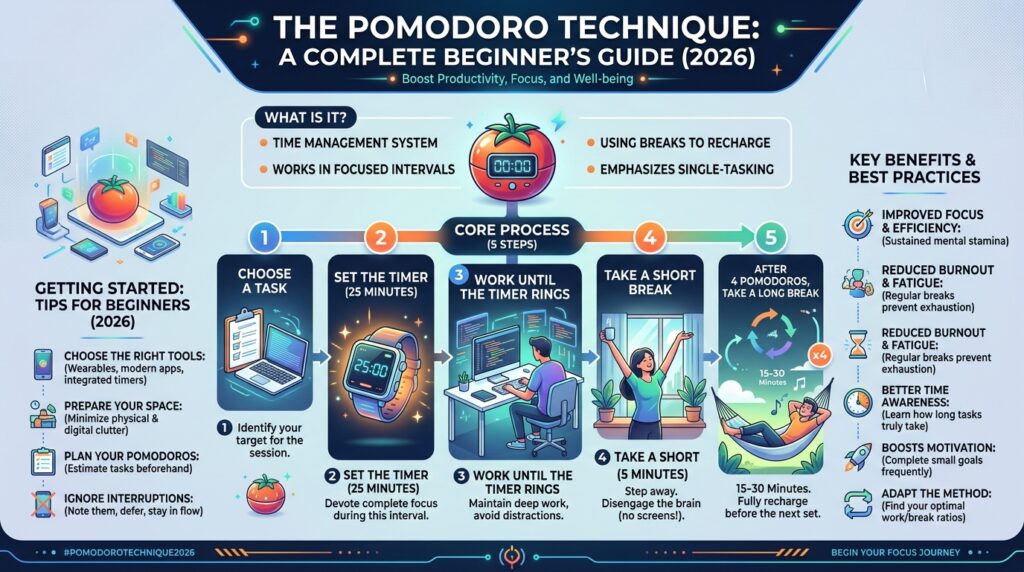
The Pomodoro Technique is a time management method that breaks your work into short, focused intervals – typically 25 minutes – separated by short breaks. Each interval is called a “pomodoro,” the Italian word for tomato.
The idea behind it is refreshingly simple: your brain can sustain intense focus for a limited window of time, after which it needs a brief rest to recover. Instead of fighting against that limit by forcing yourself to work for hours without a break, the Pomodoro Technique works with it.
In 2026, with constant notifications, hybrid work schedules, and an endless stream of digital distractions, the technique has become more relevant than ever. It gives your day a rhythm – work, rest, work, rest – that protects your attention instead of draining it.
Let’s look at where this method came from.
The History Behind the Tomato Timer
The Pomodoro Technique was created in the late 1980s by Francesco Cirillo, an Italian university student who was struggling to study effectively. He felt overwhelmed, unfocused, and constantly distracted – a feeling most of us can relate to.
Cirillo challenged himself to focus on his studies for just 10 minutes using a kitchen timer shaped like a tomato. That small win gave him confidence, and he gradually built the system into the 25-minute structure we know today.
He later wrote a short book explaining the method, and it spread quickly because of one key reason: it required almost nothing to start. No software, no subscriptions, no complicated rules – just a timer and the willingness to commit to one task for a short period.
Decades later, despite the explosion of productivity apps, AI assistants, and project management tools, the core idea remains unchanged. That’s a strong sign the technique taps into something fundamental about how our brains work.
The Science: Why Short Bursts of Focus Work
The Pomodoro Technique isn’t just a “feel good” productivity hack – there’s real science behind why it’s effective.
1. Attention naturally fluctuates. Researchers studying attention spans have found that sustained focus tends to dip after a certain period, especially during repetitive or mentally demanding tasks. Working in shorter blocks aligns your effort with your brain’s natural attention cycles instead of fighting them.
2. Breaks reduce mental fatigue. Continuous work without rest leads to a buildup of mental fatigue, which shows up as reduced concentration, more mistakes, and slower thinking. Short breaks act like a reset button, helping you return to the task with renewed energy.
3. Deadlines create urgency. When you know you only have 25 minutes, your brain treats the task differently. This is related to Parkinson’s Law – the idea that work expands or contracts to fit the time available. A ticking timer creates just enough pressure to keep you moving forward without feeling overwhelming.
4. Small wins build momentum. Completing a single pomodoro gives you a small sense of accomplishment. String a few of these together, and you build momentum that carries you through bigger projects – something that’s especially powerful for people who struggle with procrastination.
Now that you understand why it works, let’s get into exactly how to use it.
How to Start the Pomodoro Technique – Step by Step
Here’s the exact process to follow for your very first Pomodoro session today.
Step 1: Choose One Task
Pick a single task you want to work on. It should be specific enough that you know exactly what “done” looks like for this session. Instead of “work on project,” try “write the introduction section of the report” or “respond to all unread emails in inbox.”
Pro tip: If your task feels too big to finish in one sitting, break it down into smaller pieces. The Pomodoro Technique works best with tasks that can realistically progress in 25-minute chunks.
Step 2: Set a Timer for 25 Minutes
This is the “one pomodoro.” You can use your phone, a kitchen timer, a browser extension, or a dedicated app – the tool doesn’t matter as much as the commitment behind it.
Twenty-five minutes is the traditional length, but don’t worry if it feels too long or too short at first. We’ll cover how to adjust it later in this guide.
Step 3: Work Without Interruption
For the next 25 minutes, work on your chosen task and nothing else. This means:
- No checking emails or messages
- No scrolling social media “just for a second”
- No starting a different task, even if something urgent pops into your head
If a thought or task comes to mind that isn’t related to what you’re working on, quickly jot it down on a notepad and return to it later. This “capture and continue” habit prevents your focus from breaking while ensuring nothing important gets forgotten.
Step 4: Take a 5-Minute Break When the Timer Rings
When your 25 minutes are up – even if you’re in the middle of something – stop and take a break. This might feel counterintuitive, but it’s a core part of the system. The break is what allows you to sustain focus across multiple pomodoros.
During your break, do something that isn’t mentally demanding: stretch, get water, look out the window, or walk around. Avoid jumping straight into another screen-based activity, as this doesn’t give your brain the rest it needs.
Step 5: Repeat – And Take a Longer Break Every 4 Pomodoros
After completing four pomodoros (roughly two hours of focused work with breaks included), take a longer break of 15 to 30 minutes. This longer pause helps prevent burnout and keeps your energy levels steady throughout the day.
A simple way to track this is to put a tally mark or checkbox on a piece of paper after each pomodoro. Seeing your progress visually adds to the motivation.
Customizing the Technique for Your Needs
The 25-5 structure is the traditional starting point, but it isn’t a rigid rule. In fact, one of the biggest reasons beginners give up on the Pomodoro Technique is that they assume 25 minutes is mandatory for everyone, even when it doesn’t fit their work.
If 25 Minutes Feels Too Short
Some types of work – like deep coding sessions, writing, or complex problem-solving – benefit from longer blocks. Try extending to 50 minutes of work followed by a 10-minute break. This variation is sometimes called the “52-17 method,” based on research into the work habits of highly productive people.
If 25 Minutes Feels Too Long
If you’re just getting started, or if you struggle significantly with focus (which is common for people with ADHD or those returning to work after a long break from focused tasks), start smaller. Try 10 or 15-minute pomodoros with 3 to 5-minute breaks. As your focus muscle strengthens, gradually increase the time.
Adjusting Break Length
The 5-minute break is a guideline, not a law. Some people find that a 3-minute break is enough to reset, while others need a full 10 minutes, especially for physically or mentally demanding work. Experiment over a week and notice what leaves you feeling refreshed rather than reluctant to start the next pomodoro.
The golden rule: Whatever ratio you choose, keep your breaks short enough that you don’t lose momentum, but long enough that you actually feel recovered.
Who Benefits Most From This Technique?
The Pomodoro Technique works for almost anyone, but it’s especially powerful for certain groups:
Students
Studying for exams or working through dense textbook chapters becomes far more manageable when broken into pomodoros. Many students report that they retain information better because their focus is fresher during each session.
Remote Workers and Freelancers
Without the natural structure of an office environment, it’s easy for remote workers to either burn out from working too long or get distracted by household tasks. The Pomodoro Technique creates an artificial – but very effective – structure for the day.
People Who Procrastinate on Boring Tasks
Tasks like organizing files, filling out forms, or clearing a backlog of emails often get pushed aside because they feel tedious. Committing to “just one pomodoro” on a boring task feels far less intimidating than committing to “finish the whole thing,” and often you’ll find momentum carries you past the timer anyway.
Creative Professionals
Writers, designers, and developers often face the challenge of getting started – the blank page problem. Knowing you only have to focus for 25 minutes lowers the pressure enough to simply begin, which is usually the hardest part.
Common Mistakes Beginners Make
Even though the Pomodoro Technique is simple, beginners often run into a few predictable issues. Here’s how to avoid them.
Mistake #1: Treating the Timer as a Punishment
Some people see the ticking timer as added pressure and stress. Instead, try reframing it: the timer is protecting your time, not policing you. It guarantees that no matter how chaotic your day is, you get at least 25 minutes of focused progress.
Mistake #2: Skipping Breaks
It’s tempting to skip your break when you’re “in the zone,” but doing this repeatedly leads to burnout later in the day. The breaks aren’t optional extras – they’re built into the system because they make the focused time more effective.
Mistake #3: Choosing Tasks That Are Too Vague
“Work on the project” isn’t a pomodoro-friendly task because it has no clear stopping point. Always define a specific, actionable goal for each session, such as “outline the first three sections” or “fix the three bugs listed in the tracker.”
Mistake #4: Letting Interruptions Slide
If you allow “just one quick message” during your focused time, you train your brain to expect interruptions are acceptable – which defeats the purpose. Use the capture-and-continue method: write the distraction down and deal with it during your break.
Mistake #5: Giving Up After One Bad Day
Like any new habit, the first few days might feel awkward. You might get distracted halfway through a pomodoro, or find the rhythm doesn’t click immediately. That’s completely normal – give it at least a week before deciding whether it works for you.
Best Pomodoro Apps and Tools in 2026
While you technically only need a basic timer, the right app can add useful features like tracking, statistics, and distraction blocking.
- TickTick – Combines a to-do list with a built-in Pomodoro timer and habit tracker, making it a great all-in-one option.
- Forest App – Gamifies your focus sessions by growing a virtual tree during each pomodoro; leaving the app early “kills” your tree, which adds a fun layer of accountability
- Pomofocus – A free, no-signup web-based timer that’s perfect if you want to try the technique without installing anything
- Clockify – While primarily a time-tracking tool, it can also be used to log completed pomodoros and analyze how your focused time is distributed across projects
- Physical Kitchen Timer – Sometimes the simplest option is best. A physical timer removes the temptation to check your phone screen between sessions
Remember: The app is just a tool. The real value comes from consistently showing up for each focused session, not from the features of whatever timer you use.
Combining Pomodoro With Other Techniques
The Pomodoro Technique works wonderfully on its own, but it becomes even more powerful when paired with other time management systems.
Pomodoro + Eisenhower Matrix
Use the Eisenhower Matrix first thing in the morning to identify your most important and urgent tasks. Then use pomodoros throughout the day to actually execute those tasks one at a time.
Pomodoro + Time Blocking
If you already use time blocking to structure your calendar, pomodoros fit neatly inside each block. For example, a 2-hour block for “deep work” could naturally contain four pomodoros with breaks built in.
Pomodoro + MIT Method
Identify your Most Important Task for the day, then attack it with your first pomodoro of the morning – before checking email or messages. This combination ensures your highest-priority work gets your freshest energy.
For a deeper breakdown of how these systems fit together, check out our complete guide to the best time management techniques.
Frequently Asked Questions
Is 25 minutes the only correct length for a pomodoro?
No. While 25 minutes is the traditional and most commonly used length, it isn’t a strict rule. Many people successfully use 15, 30, 45, or even 50-minute sessions depending on the type of work and their personal attention span. The key principle – focused work followed by a real break – matters far more than the exact numbers.
What should I do during my break?
The best breaks involve stepping away from your screen. Stretching, walking, getting a drink of water, or simply looking out a window all work well. Try to avoid activities that are just as mentally stimulating as work, such as scrolling social media, since this doesn’t give your brain the rest it needs.
What if I get interrupted during a pomodoro?
If the interruption is unavoidable – like an urgent call – pause your timer, handle it, and then either restart the pomodoro or continue where you left off, depending on how long the interruption was. For minor interruptions (a thought, a notification), write it down and continue without stopping the timer.
Can I use the Pomodoro Technique for creative work like writing?
Yes, and many writers swear by it. Knowing you only need to write for 25 minutes lowers the resistance to starting. Some creative workers prefer slightly longer sessions (40-50 minutes) to allow for deeper immersion, but the core structure of focused work followed by breaks still applies.
How many pomodoros should I aim for in a day?
This depends entirely on the type of work and your energy levels. Many people find that 8 to 12 pomodoros (roughly 4 to 6 hours of deep focused work) is a realistic and sustainable target for a full workday, with the remaining time spent on meetings, breaks, and lower-focus tasks.
Conclusion: Your First Pomodoro Starts Now
The Pomodoro Technique proves that you don’t need a complicated system to dramatically improve your focus – you just need structure, a timer, and the willingness to protect short blocks of your time.
Here’s a quick recap of what you’ve learned:
- What it is: Short focused work sessions (typically 25 minutes) followed by short breaks
- Why it works: It aligns with your brain’s natural attention cycles and reduces mental fatigue
- How to start: Pick a task, set a timer, work without interruption, then take a break
- How to customize it: Adjust the work and break lengths to fit your own focus levels
- How to avoid common mistakes: Don’t skip breaks, choose specific tasks, and give it more than one day
Do this one thing today: Pick one task, set a timer for 25 minutes, and start right now. That’s the entire technique – the rest is just repetition.